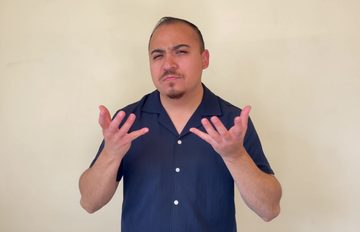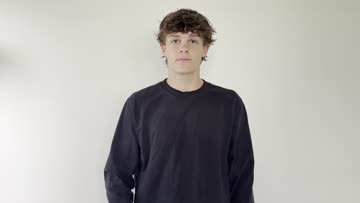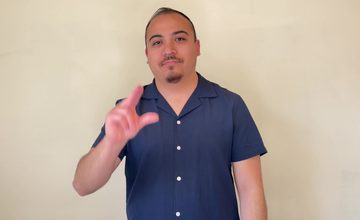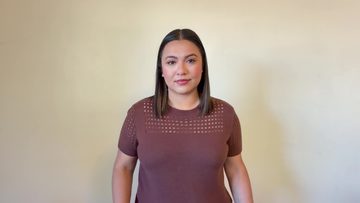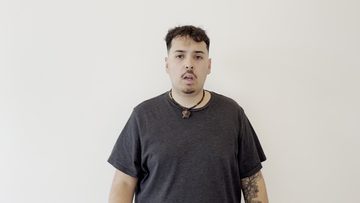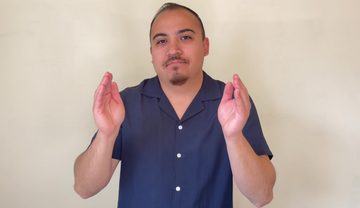
Beginners think of facial expression in ASL as emotion: smile when you are happy, frown when you are sad. That is true, but it is the smallest part of the story. In ASL, the face carries grammar. Eyebrows mark questions. A head shake negates. The mouth marks size, distance, and intensity. Linguists call these non-manual markers, and they are as much a part of the language as word endings are in Spanish.
A signer with perfect hands and a flat face is producing a sentence with the grammar stripped out. Here is what the face does, and how to practice it.
Eyebrows up: yes-or-no question
Raise your eyebrows, tilt your head slightly forward, and hold it through the sentence. Any statement becomes a question. YOU HUNGRY with raised eyebrows is "Are you hungry?" There is no DO or ARE sign to add. The eyebrows are the whole difference.
Hold the eyebrows until you get an answer. Dropping them early makes the question read as a statement that trailed off.
Eyebrows down: WH-question
For who, what, where, when, why, how, which, the eyebrows go down and together, with a slight forward lean. The question word usually comes at the end, and the eyebrows stay down on it.
YOUR NAME WHAT? with the brows down on WHAT. Without the brows, What on its own looks like a shrug.
Head shake: negation
Shaking your head while you sign negates the sentence, with or without a NOT sign. I LIKE COFFEE with a head shake across LIKE COFFEE means "I don't like coffee." Fluent signers often drop the negative sign entirely and let the head do it.
No, Don't Know, and Not Yet all come with a head shake built in. Practice them with the head moving, not just the hands.
Head nod: affirmation and completion
A nod while you sign affirms. I FINISH with a nod is "Yes, I finished." A nod at the end of a sentence is a period. Watch fluent signers and you will see small nods closing almost every statement.
Mouth: size, distance, and intensity
The mouth adds adverbs. Puffed cheeks mean big, far, a lot, or a long time. Pursed lips (like a tiny "oo") mean small, near, thin, or carefully. Tongue slightly out through the teeth means carelessly or without paying attention. An open mouth with a slight breath means with effort.
Big with puffed cheeks is huge. Small with pursed lips is tiny. The hands do the base word; the mouth does the degree.
Raised eyebrows: topic marking
ASL often sets a topic at the start of a sentence with raised eyebrows and a slight pause, then comments on it with a neutral face. COFFEE (brows up, pause) I DON'T-LIKE. This is the same eyebrows as a yes-or-no question, which confuses beginners; the difference is the pause and the fact that the sentence continues. See ASL grammar.
Eye gaze: pronouns and role shift
Where you look is grammar too. Looking at a spot you have set up for someone, while you sign, is enough to mean "he" or "she." Shifting your body and gaze to that spot and signing from it means you are quoting that person. This is how ASL does dialogue without saying "he said, she said."
Emotion is on top of all this
And then, yes, emotion. Happy with a smile, Sad with the face falling, Angry with a tight jaw. The emotion layer sits on top of the grammar layer, and a fluent signer does both at once: a sad face with raised eyebrows is "Are you sad?"
How to practice
- Mirror work, exaggerated. For one week, overdo every eyebrow and head movement in the mirror. It feels absurd. It calibrates you.
- Five questions a day. Ask yourself five questions, alternating yes-or-no and WH, with the eyebrows. Answer each with a nod or shake.
- Watch with the sound off. Watch Deaf creators and try to identify questions, negations, and topics from the face alone before you read the hands.
- Record yourself. Most beginners think their face is moving. The camera will tell you it is not.
The hands are the easy part. The face is the part that makes you understood. Start with the question words guide and do every clip with the eyebrows.