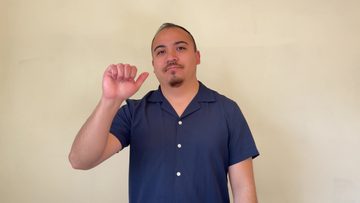
No. There is no single sign language that Deaf people around the world share, any more than there is a single spoken language. There are somewhere between 150 and 300 distinct sign languages in use today, and they are as different from each other as French is from Japanese. A Deaf American and a Deaf Briton do not understand each other's signing, even though both of their countries speak English.
This surprises almost everyone, and the reason it surprises people is interesting.
Why people assume it is universal
Signs look like gestures, and gestures feel universal. Pointing, waving, miming a drink. Some signs are iconic in exactly that way, like Drink or Eat, and those do tend to be recognizable across languages. But most of a sign language is not iconic. Mother, Why, Tuesday look nothing like what they mean. They are arbitrary, like spoken words, and each Deaf community developed its own.
Where sign languages come from
Sign languages are born wherever Deaf people gather in numbers large enough to form a community, most often around schools for the Deaf. The school brings children together, the children bring home signs and local gestures, and within a generation a full language emerges. This has been observed directly: Nicaraguan Sign Language appeared in the 1980s when Nicaragua opened its first Deaf schools, and linguists watched it become a language.
Because sign languages come from Deaf communities and not from spoken languages, their family trees do not match the spoken ones. ASL descends from French Sign Language, because a Deaf French teacher helped found the first American Deaf school in 1817. British Sign Language is unrelated to both. We covered that history in ASL vs BSL.
ASL's relatives
ASL is used in the United States and most of English-speaking Canada. It is closely related to French Sign Language (LSF) and partly intelligible with it. Through Deaf education missions, ASL influenced sign languages across West Africa (Ghana, Nigeria), parts of Southeast Asia (the Philippines, Thailand), and elsewhere, so an ASL signer will find familiar vocabulary in places English speakers would not expect.
Quebec has its own language, LSQ, which draws on both LSF and ASL. Mexico has LSM, which is its own language, related to LSF and Spanish Sign Language but not to ASL.
What about International Sign?
International Sign is a real thing, but it is not a language in the full sense. It is a contact system, a kind of signed pidgin, that Deaf people use at international events like the Deaflympics and World Federation of the Deaf congresses. It borrows widely understood signs, leans heavily on iconic gesture and shared Deaf cultural knowledge, and varies depending on who is using it. Nobody grows up speaking it. It works for a conference; it would not work for raising a child.
Why this is good news
A universal sign language would mean one Deaf culture, one history, one way of being Deaf. The reality is hundreds of Deaf communities, each with its own language, humor, poetry, and traditions. ASL has its own literature and its own storytelling forms. So does BSL, so does LSF, so does Japanese Sign Language. The diversity is the same diversity as spoken languages, and it is worth exactly as much.
For a learner, it also means your choice is simple: learn the sign language of the Deaf community you will actually be part of. In the United States and Canada, that is ASL, and the first fifty signs are a good place to start.
Quick answers
- Is ASL used in England? No. England uses BSL, which is unrelated.
- Is ASL used in Canada? Yes, in English-speaking Canada. Quebec mostly uses LSQ.
- Can an ASL signer understand French Sign Language? Partly. They are related, like Spanish and Italian.
- Is there a universal sign language? No. International Sign is a contact system for events, not a native language.
- How many sign languages are there? Linguists have catalogued over 150, and estimates run to 300 or more, with new ones still being documented.