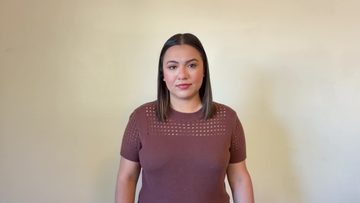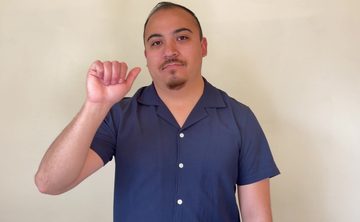
American Sign Language and British Sign Language are not two accents of one language. They are two languages, as different from each other as English is from Hungarian. A fluent ASL signer dropped into a BSL conversation would understand almost nothing, and vice versa. This surprises people, because the two countries share a spoken language. But sign languages do not come from spoken languages. They come from Deaf communities, and the American and British Deaf communities grew up separately.
Different alphabets
The clearest difference is the alphabet. ASL fingerspells on one hand: twenty-six handshapes, as shown in our alphabet guide.
BSL fingerspells on two hands. Vowels are the fingertips of one hand touched by the index finger of the other. Consonants are two-handed shapes. Someone who reads ASL fingerspelling fluently cannot read BSL fingerspelling at all without learning it from scratch.
Different vocabulary
Nearly every sign is different. Hello, Thank You, Deaf, Sign Language all look different in BSL. A handful of signs are similar because they are iconic, like drinking from a cup or pointing to yourself, but the overlap is small, around the level of two unrelated spoken languages sharing a few borrowed words.
Different histories
ASL descends mostly from French Sign Language (LSF). In 1817, Thomas Hopkins Gallaudet brought a Deaf French teacher, Laurent Clerc, to found the first American school for the Deaf in Hartford, Connecticut. Clerc taught in LSF, students arrived with their own home signs and regional signs, including a rich sign language from Martha's Vineyard, and ASL grew out of that mix. ASL and LSF still share a lot of vocabulary today; a French signer and an American signer can often get by.
BSL developed in Britain's Deaf schools and communities with no French connection. It is related to Australian Sign Language (Auslan) and New Zealand Sign Language, which descend from it through British emigration. Linguists group those three as the BANZSL family. ASL is not in it.
Different grammar, same principles
The grammars differ in detail but share the deep features of sign languages generally: facial expressions carry grammar, space is used for pronouns and verb agreement, and time is set at the start of the sentence. If you learn ASL and later learn BSL, the concepts transfer even though the signs do not. Our grammar post covers these principles in ASL.
Which should you learn?
Learn the sign language of the Deaf community you will actually be part of. If you live in the United States or most of Canada, that is ASL. If you live in the United Kingdom, that is BSL. If you are in Australia or New Zealand, Auslan or NZSL. Learning ASL in London will not help you talk to Deaf Londoners.
If you have no community constraint and are choosing for other reasons, ASL has more learning resources online, a larger population of signers, and the related languages of LSF, Quebec Sign Language (LSQ) shares some ground, and many sign languages in West Africa and Southeast Asia that were influenced by ASL through Deaf education missions.
Is there a universal sign language?
No, and there is not a universal spoken language either. There is something called International Sign, a simplified contact system used at international Deaf events, but it is not anyone's native language. We wrote more about this in is sign language universal.
The sign ASL is fingerspelled A-S-L. America / USA interlocks the fingers and circles. If you are learning ASL, those are the two signs you will use to say what language you are learning and where it comes from.