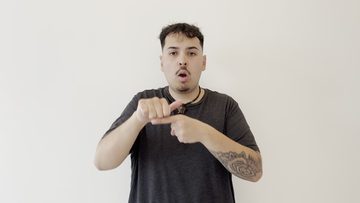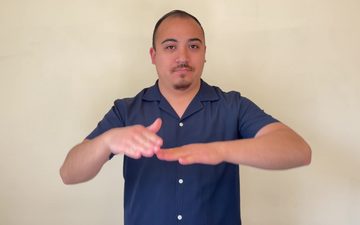
There is a myth that languages are for children and adults are too late. It is not true for spoken languages and it is not true for ASL. Adults learn differently, not worse. You have a bigger attention span, you can take instruction, you understand what grammar is, and you can decide to practice. Children do not do any of that; they just get thousands of hours of immersion. You will not get that, so you need a different plan.
Here is what works, specifically for adults.
Use your strengths: patterns and reasons
Children learn Mother and Father as two separate facts. You can learn that female family signs are made at the chin and male ones at the forehead, and then you have half the family category in one rule. The same goes for colors (most are shaken letters), days of the week (circled letters), and numbers (digit plus zero for the tens).
Adults learn fastest when they understand why. Every guide on this site explains the rule under the signs for that reason.
Go video-first, always
Signs are movement in space. Adults who learned from a book or a chart of hand drawings often produce signs that are technically the right handshape and still unreadable, because the movement and the rhythm were never shown. Learn from video, sign along with the video, and when you practice, record yourself and compare.
Every sign in our dictionary is a filmed clip with a half-speed button for exactly this reason.
Short daily sessions beat long weekly ones
The adult schedule problem is real. The solution is not finding two free hours; it is finding fifteen minutes. Signs decay fast in the first weeks without repetition. Ten signs a day with a two-minute review of yesterday's ten will outpace a Saturday marathon by a wide margin.
Build it into something you already do. Sign your morning: Morning, Coffee, Work. Sign your feelings at lunch. Sign your plans at night. Nobody has to see it.
Receptive practice first
Adults tend to want to produce. Watch the clip, copy the sign, move on. But understanding other people's signing is harder than producing your own, and it is the skill that unlocks conversation. Spend at least a third of your practice time watching signs and naming them before you produce anything. Recognition drills, the kind in the practice widget on every guide, are the fastest route.
Accept the plateau
Almost everyone hits a wall around week six to eight. You know a couple hundred signs, you can introduce yourself, and then conversations with real signers feel impossible: too fast, too much fingerspelling, too much face. This is normal and it is where most adults quit.
The way through is not more vocabulary. It is exposure to real signing. Deaf vloggers, interpreted news, Deaf creators on video platforms. Watch without trying to understand everything. Your eyes learn to read fingerspelling and faces by watching, not by drilling.
Find real signers
You will not get fluent alone. ASL is a community's language and you learn it by being in the community. Options for adults:
- Community college ASL classes, usually taught by Deaf instructors.
- Deaf coffee chats and ASL meetups; many cities have them monthly.
- Online conversation partners through tutoring platforms, especially Deaf tutors.
- Deaf events, which are usually public and welcoming to learners who are honest about being learners.
When you go, lead with I'm Learning ASL and I Sign A Little. Then do your best. People are generous.
Let your face go
The adult-specific obstacle nobody warns you about: self-consciousness. Children make faces without thinking. Adults have spent decades learning to keep a neutral face in public. ASL requires the opposite. Eyebrows, head tilts, puffed cheeks, and a shaking head are grammar, not emotion, and a flat-faced signer is hard to understand.
Practice in a mirror. Exaggerate on purpose for a week. It feels silly and it works. See facial expressions in ASL.
Ask for repeats without embarrassment
Sign Again and Sign Slow are normal sentences in ASL, used between fluent signers all the time. Use them freely. Nobody is annoyed; the only annoying thing is nodding along when you did not understand.
The honest timeline
Daily practice gets most adults to a polite introduction in a week, a beginner's conversation in a month or two, and a comfortable slow conversation in six months with real-world practice. We wrote a longer answer in how long does it take to learn ASL.
You are not too late. Start with the alphabet tonight.